


Android is an open source and Linux-based operating system for mobile devices such as smartphones and tablet computers. Android was developed by the Open Handset Alliance, led by Google, and other companies. This tutorial will teach you basic Android programming and will also take you through some advance concepts related to Android application development.
Audience
This tutorial has been prepared for the beginners to help them understand basic Android programming. After completing this tutorial you will find yourself at a moderate level of expertise in Android programming from where you can take yourself to next levels.
Prerequisites
Android programming is based on Java programming language so if you have basic understanding on Java programming then it will be a fun to learn Android application development.
Android – Overview
What is Android?

Android is an open source and Linux-based Operating System for mobile devices such as smartphones and tablet computers. Android was developed by the Open Handset Alliance, led by Google, and other companies.
Android offers a unified approach to application development for mobile devices which means developers need only develop for Android, and their applications should be able to run on different devices powered by Android.
The first beta version of the Android Software Development Kit (SDK) was released by Google in 2007 where as the first commercial version, Android 1.0, was released in September 2008.
On June 27, 2012, at the Google I/O conference, Google announced the next Android version, 4.1 Jelly Bean. Jelly Bean is an incremental update, with the primary aim of improving the user interface, both in terms of functionality and performance.
The source code for Android is available under free and open source software licenses. Google publishes most of the code under the Apache License version 2.0 and the rest, Linux kernel changes, under the GNU General Public License version 2.
Why Android ?
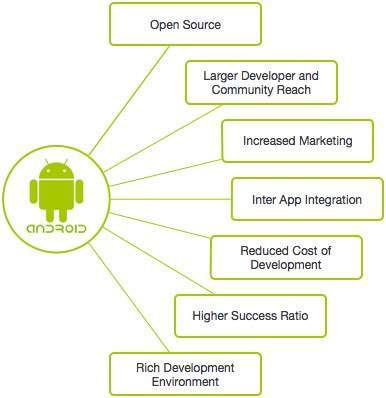
Features of Android
Android is a powerful operating system competing with Apple 4GS and supports great features. Few of them are listed below −
| Sr.No. | Feature & Description |
|---|---|
| 1 | Beautiful UIAndroid OS basic screen provides a beautiful and intuitive user interface. |
| 2 | ConnectivityGSM/EDGE, IDEN, CDMA, EV-DO, UMTS, Bluetooth, Wi-Fi, LTE, NFC and WiMAX. |
| 3 | StorageSQLite, a lightweight relational database, is used for data storage purposes. |
| 4 | Media supportH.263, H.264, MPEG-4 SP, AMR, AMR-WB, AAC, HE-AAC, AAC 5.1, MP3, MIDI, Ogg Vorbis, WAV, JPEG, PNG, GIF, and BMP. |
| 5 | MessagingSMS and MMS |
| 6 | Web browserBased on the open-source WebKit layout engine, coupled with Chrome’s V8 JavaScript engine supporting HTML5 and CSS3. |
| 7 | Multi-touchAndroid has native support for multi-touch which was initially made available in handsets such as the HTC Hero. |
| 8 | Multi-taskingUser can jump from one task to another and same time various application can run simultaneously. |
| 9 | Resizable widgetsWidgets are resizable, so users can expand them to show more content or shrink them to save space. |
| 10 | Multi-LanguageSupports single direction and bi-directional text. |
| 11 | GCMGoogle Cloud Messaging (GCM) is a service that lets developers send short message data to their users on Android devices, without needing a proprietary sync solution. |
| 12 | Wi-Fi DirectA technology that lets apps discover and pair directly, over a high-bandwidth peer-to-peer connection. |
| 13 | Android BeamA popular NFC-based technology that lets users instantly share, just by touching two NFC-enabled phones together. |
Android Applications
Android applications are usually developed in the Java language using the Android Software Development Kit.
Once developed, Android applications can be packaged easily and sold out either through a store such as Google Play, SlideME, Opera Mobile Store, Mobango, F-droid and the Amazon Appstore.
Android powers hundreds of millions of mobile devices in more than 190 countries around the world. It’s the largest installed base of any mobile platform and growing fast. Every day more than 1 million new Android devices are activated worldwide.
This tutorial has been written with an aim to teach you how to develop and package Android application. We will start from environment setup for Android application programming and then drill down to look into various aspects of Android applications.
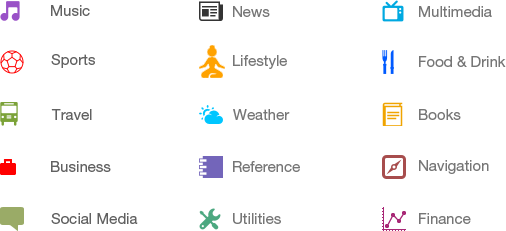
Categories of Android applications
There are many android applications in the market. The top categories are −
History of Android
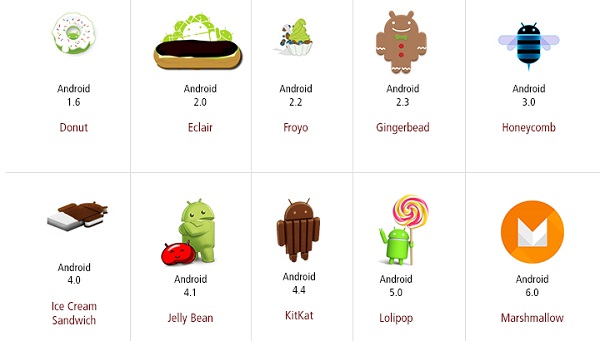
The code names of android ranges from A to N currently, such as Aestro, Blender, Cupcake, Donut, Eclair, Froyo, Gingerbread, Honeycomb, Ice Cream Sandwitch, Jelly Bean, KitKat, Lollipop and Marshmallow. Let’s understand the android history in a sequence.
What is API level?
API Level is an integer value that uniquely identifies the framework API revision offered by a version of the Android platform.
| Platform Version | API Level | VERSION_CODE | |
|---|---|---|---|
| Android 6.0 | 23 | MARSHMALLOW | |
| Android 5.1 | 22 | LOLLIPOP_MR1 | |
| Android 5.0 | 21 | LOLLIPOP | |
| Android 4.4W | 20 | KITKAT_WATCH | KitKat for Wearables Only |
| Android 4.4 | 19 | KITKAT | |
| Android 4.3 | 18 | JELLY_BEAN_MR2 | |
| Android 4.2, 4.2.2 | 17 | JELLY_BEAN_MR1 | |
| Android 4.1, 4.1.1 | 16 | JELLY_BEAN | |
| Android 4.0.3, 4.0.4 | 15 | ICE_CREAM_SANDWICH_MR1 | |
| Android 4.0, 4.0.1, 4.0.2 | 14 | ICE_CREAM_SANDWICH | |
| Android 3.2 | 13 | HONEYCOMB_MR2 | |
| Android 3.1.x | 12 | HONEYCOMB_MR1 | |
| Android 3.0.x | 11 | HONEYCOMB | |
| Android 2.3.4Android 2.3.3 | 10 | GINGERBREAD_MR1 | |
| Android 2.3.2Android 2.3.1Android 2.3 | 9 | GINGERBREAD | |
| Android 2.2.x | 8 | FROYO | |
| Android 2.1.x | 7 | ECLAIR_MR1 | |
| Android 2.0.1 | 6 | ECLAIR_0_1 | |
| Android 2.0 | 5 | ECLAIR | |
| Android 1.6 | 4 | DONUT | |
| Android 1.5 | 3 | CUPCAKE | |
| Android 1.1 | 2 | BASE_1_1 | |
| Android 1.0 | 1 | BASE |
Android – Architecture
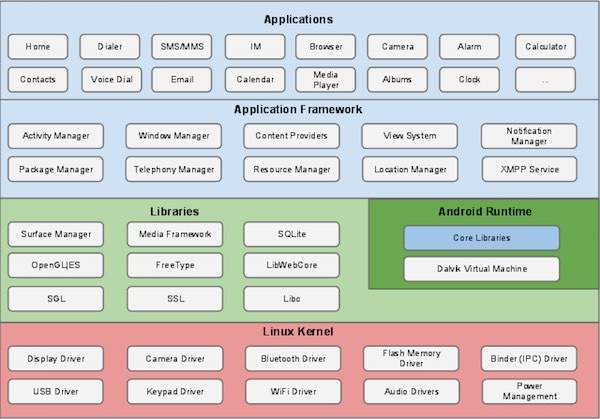
Android operating system is a stack of software components which is roughly divided into five sections and four main layers as shown below in the architecture diagram.
Linux kernel
At the bottom of the layers is Linux – Linux 3.6 with approximately 115 patches. This provides a level of abstraction between the device hardware and it contains all the essential hardware drivers like camera, keypad, display etc. Also, the kernel handles all the things that Linux is really good at such as networking and a vast array of device drivers, which take the pain out of interfacing to peripheral hardware.
Libraries
On top of Linux kernel there is a set of libraries including open-source Web browser engine WebKit, well known library libc, SQLite database which is a useful repository for storage and sharing of application data, libraries to play and record audio and video, SSL libraries responsible for Internet security etc.
Android Libraries
This category encompasses those Java-based libraries that are specific to Android development. Examples of libraries in this category include the application framework libraries in addition to those that facilitate user interface building, graphics drawing and database access. A summary of some key core Android libraries available to the Android developer is as follows −
- android.app − Provides access to the application model and is the cornerstone of all Android applications.
- android.content − Facilitates content access, publishing and messaging between applications and application components.
- android.database − Used to access data published by content providers and includes SQLite database management classes.
- android.opengl − A Java interface to the OpenGL ES 3D graphics rendering API.
- android.os − Provides applications with access to standard operating system services including messages, system services and inter-process communication.
- android.text − Used to render and manipulate text on a device display.
- android.view − The fundamental building blocks of application user interfaces.
- android.widget − A rich collection of pre-built user interface components such as buttons, labels, list views, layout managers, radio buttons etc.
- android.webkit − A set of classes intended to allow web-browsing capabilities to be built into applications.
Having covered the Java-based core libraries in the Android runtime, it is now time to turn our attention to the C/C++ based libraries contained in this layer of the Android software stack.
Android Runtime
This is the third section of the architecture and available on the second layer from the bottom. This section provides a key component called Dalvik Virtual Machine which is a kind of Java Virtual Machine specially designed and optimized for Android.
The Dalvik VM makes use of Linux core features like memory management and multi-threading, which is intrinsic in the Java language. The Dalvik VM enables every Android application to run in its own process, with its own instance of the Dalvik virtual machine.
The Android runtime also provides a set of core libraries which enable Android application developers to write Android applications using standard Java programming language.
Application Framework
The Application Framework layer provides many higher-level services to applications in the form of Java classes. Application developers are allowed to make use of these services in their applications.
The Android framework includes the following key services −
- Activity Manager − Controls all aspects of the application lifecycle and activity stack.
- Content Providers − Allows applications to publish and share data with other applications.
- Resource Manager − Provides access to non-code embedded resources such as strings, color settings and user interface layouts.
- Notifications Manager − Allows applications to display alerts and notifications to the user.
- View System − An extensible set of views used to create application user interfaces.
Applications
You will find all the Android application at the top layer. You will write your application to be installed on this layer only. Examples of such applications are Contacts Books, Browser, Games etc.
Android – Application Components
Application components are the essential building blocks of an Android application. These components are loosely coupled by the application manifest file AndroidManifest.xml that describes each component of the application and how they interact.
There are following four main components that can be used within an Android application −
| Sr.No | Components & Description |
|---|---|
| 1 | ActivitiesThey dictate the UI and handle the user interaction to the smart phone screen. |
| 2 | ServicesThey handle background processing associated with an application. |
| 3 | Broadcast ReceiversThey handle communication between Android OS and applications. |
| 4 | Content ProvidersThey handle data and database management issues. |
Activities
An activity represents a single screen with a user interface,in-short Activity performs actions on the screen. For example, an email application might have one activity that shows a list of new emails, another activity to compose an email, and another activity for reading emails. If an application has more than one activity, then one of them should be marked as the activity that is presented when the application is launched.
An activity is implemented as a subclass of Activity class as follows −
public class MainActivity extends Activity {
}
Services
A service is a component that runs in the background to perform long-running operations. For example, a service might play music in the background while the user is in a different application, or it might fetch data over the network without blocking user interaction with an activity.
A service is implemented as a subclass of Service class as follows −
public class MyService extends Service {
}
Broadcast Receivers
Broadcast Receivers simply respond to broadcast messages from other applications or from the system. For example, applications can also initiate broadcasts to let other applications know that some data has been downloaded to the device and is available for them to use, so this is broadcast receiver who will intercept this communication and will initiate appropriate action.
A broadcast receiver is implemented as a subclass of BroadcastReceiver class and each message is broadcaster as an Intent object.
public class MyReceiver  extends  BroadcastReceiver {
   public void onReceive(context,intent){}
}
Content Providers
A content provider component supplies data from one application to others on request. Such requests are handled by the methods of the ContentResolver class. The data may be stored in the file system, the database or somewhere else entirely.
A content provider is implemented as a subclass of ContentProvider class and must implement a standard set of APIs that enable other applications to perform transactions.
public class MyContentProvider extends  ContentProvider {
   public void onCreate(){}
}
We will go through these tags in detail while covering application components in individual chapters.
Additional Components
There are additional components which will be used in the construction of above mentioned entities, their logic, and wiring between them. These components are −
| S.No | Components & Description |
|---|---|
| 1 | FragmentsRepresents a portion of user interface in an Activity. |
| 2 | ViewsUI elements that are drawn on-screen including buttons, lists forms etc. |
| 3 | LayoutsView hierarchies that control screen format and appearance of the views. |
| 4 | IntentsMessages wiring components together. |
| 5 | ResourcesExternal elements, such as strings, constants and drawable pictures. |
| 6 | ManifestConfiguration file for the application. |
Android – Hello World Example
Let us start actual programming with Android Framework. Before you start writing your first example using Android SDK, you have to make sure that you have set-up your Android development environment properly as explained in Android – Environment Set-up tutorial. I also assume that you have a little bit working knowledge with Android studio.
So let us proceed to write a simple Android Application which will print “Hello World!”.
Create Android Application
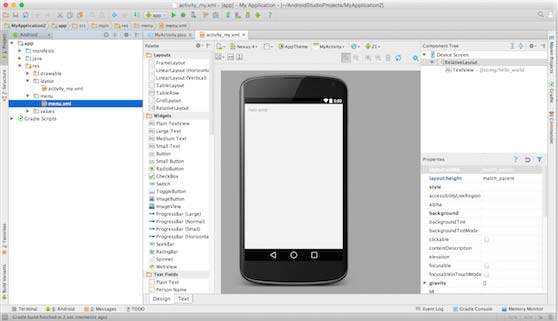
The first step is to create a simple Android Application using Android studio. When you click on Android studio icon, it will show screen as shown below
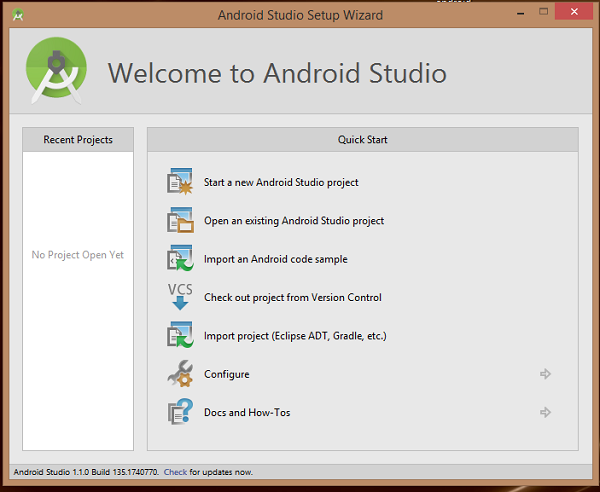
You can start your application development by calling start a new android studio project. in a new installation frame should ask Application name, package information and location of the project.−
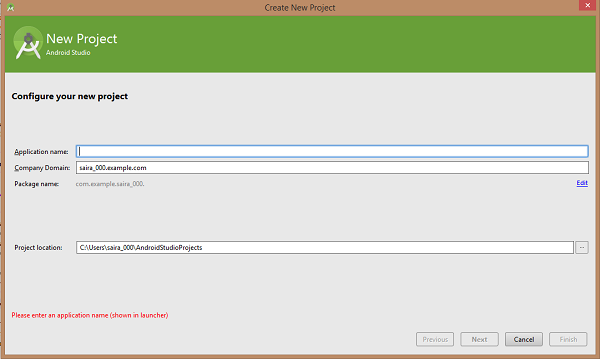
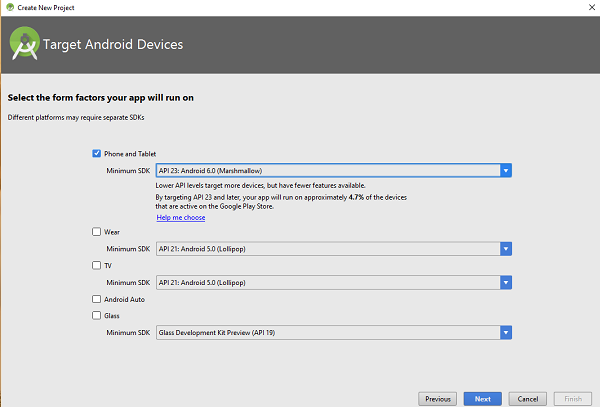
After entered application name, it going to be called select the form factors your application runs on, here need to specify Minimum SDK, in our tutorial, I have declared as API23: Android 6.0(Mashmallow) −
The next level of installation should contain selecting the activity to mobile, it specifies the default layout for Applications.
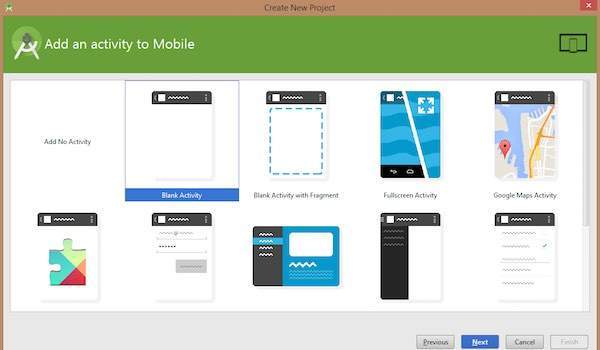
At the final stage it going to be open development tool to write the application code.
Anatomy of Android Application
Before you run your app, you should be aware of a few directories and files in the Android project −
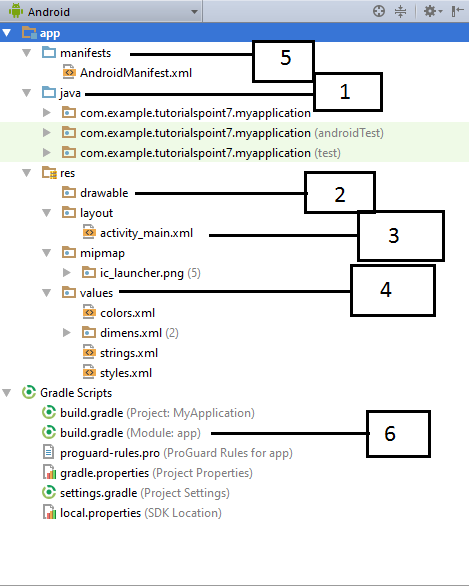
| Sr.No. | Folder, File & Description |
|---|---|
| 1 | JavaThis contains the .java source files for your project. By default, it includes an MainActivity.java source file having an activity class that runs when your app is launched using the app icon. |
| 2 | res/drawable-hdpiThis is a directory for drawable objects that are designed for high-density screens. |
| 3 | res/layoutThis is a directory for files that define your app’s user interface. |
| 4 | res/valuesThis is a directory for other various XML files that contain a collection of resources, such as strings and colours definitions. |
| 5 | AndroidManifest.xmlThis is the manifest file which describes the fundamental characteristics of the app and defines each of its components. |
| 6 | Build.gradleThis is an auto generated file which contains compileSdkVersion, buildToolsVersion, applicationId, minSdkVersion, targetSdkVersion, versionCode and versionName |
Following section will give a brief overview of the important application files.
The Main Activity File
The main activity code is a Java file MainActivity.java. This is the actual application file which ultimately gets converted to a Dalvik executable and runs your application. Following is the default code generated by the application wizard for Hello World! application −
package com.example.helloworld;

import android.support.v7.app.AppCompatActivity;
import android.os.Bundle;

public class MainActivity extends AppCompatActivity {
      @Override
      protected void onCreate(Bundle savedInstanceState{
               super.onCreate(savedInstanceState);
               setContentView(R.layout.activity_main);
      }
}
Here, R.layout.activity_main refers to the activity_main.xml file located in the res/layout folder. The onCreate() method is one of many methods that are figured when an activity is loaded.
The Manifest File
Whatever component you develop as a part of your application, you must declare all its components in a manifest.xml which resides at the root of the application project directory. This file works as an interface between Android OS and your application, so if you do not declare your component in this file, then it will not be considered by the OS. For example, a default manifest file will look like as following file −
<?xml version="1.0" encoding="utf-8"?>
<manifest xmlns:android="http://schemas.android.com/apk/res/android"package="com.example.tutorialspoint7.myapplication">

  <application
    android:allowBackup="true"
    android:icon="@mipmap/ic_launcher"
    android:label="@string/app_name"
    android:supportsRtl="true"
    android:theme="@style/AppTheme">

    <activity android:name=".MainActivity">
      <intent-filter>
         <action android:name="android.intent.action.MAIN"/>
         <category android:name="android.intent.category.LAUNCHER"/>
      </intent-filter>
    </activity>
  </application>
</manifest>
Here <application>…</application> tags enclosed the components related to the application. Attribute android:icon will point to the application icon available under res/drawable-hdpi. The application uses the image named ic_launcher.png located in the drawable folders
The <activity> tag is used to specify an activity and android:name attribute specifies the fully qualified class name of the Activity subclass and the android:label attributes specifies a string to use as the label for the activity. You can specify multiple activities using <activity> tags.
The action for the intent filter is named android.intent.action.MAIN to indicate that this activity serves as the entry point for the application. The category for the intent-filter is named android.intent.category.LAUNCHER to indicate that the application can be launched from the device’s launcher icon.
The @string refers to the strings.xml file explained below. Hence, @string/app_name refers to the app_name string defined in the strings.xml file, which is “HelloWorld”. Similar way, other strings get populated in the application.
Following is the list of tags which you will use in your manifest file to specify different Android application components −
- <activity>elements for activities
- <service> elements for services
- <receiver> elements for broadcast receivers
- <provider> elements for content providers
The Strings File
The strings.xml file is located in the res/values folder and it contains all the text that your application uses. For example, the names of buttons, labels, default text, and similar types of strings go into this file. This file is responsible for their textual content. For example, a default strings file will look like as following file −
<resources>
     <string name="app_name">HelloWorld</string>
     <string name="hello_world">Hello world!</string>
     <string name="menu_settings">Settings</string>
     <string name="title_activity_main">MainActivity</string>
</resources>
The Layout File
The activity_main.xml is a layout file available in res/layout directory, that is referenced by your application when building its interface. You will modify this file very frequently to change the layout of your application. For your “Hello World!” application, this file will have following content related to default layout −
<RelativeLayout xmlns:android="http://schemas.android.com/apk/res/android"
   xmlns:tools="http://schemas.android.com/tools"
   android:layout_width="match_parent"
   android:layout_height="match_parent">

   <TextView
      android:layout_width="wrap_content"
      android:layout_height="wrap_content"
      android:layout_centerHorizontal="true"
      android:layout_centerVertical="true"
      android:padding="@dimen/padding_medium"
      android:text="@string/hello_world"
      tools:context=".MainActivity"/>

</RelativeLayout>
This is an example of simple RelativeLayout which we will study in a separate chapter. The TextView is an Android control used to build the GUI and it have various attributes like android:layout_width, android:layout_height etc which are being used to set its width and height etc.. The @string refers to the strings.xml file located in the res/values folder. Hence, @string/hello_world refers to the hello string defined in the strings.xml file, which is “Hello World!”.
Running the Application
Let’s try to run our Hello World! application we just created. I assume you had created your AVD while doing environment set-up. To run the app from Android studio, open one of your project’s activity files and click Run  icon from the tool bar. Android studio installs the app on your AVD and starts it and if everything is fine with your set-up and application, it will display following Emulator window −
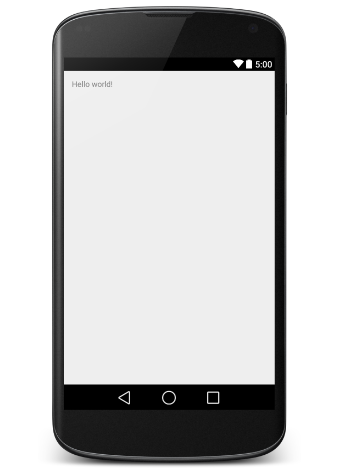
Congratulations!!! you have developed your first Android Application and now just keep following rest of the tutorial step by step to become a great Android Developer. All the very best.
Android Resources Organizing & Accessing
There are many more items which you use to build a good Android application. Apart from coding for the application, you take care of various other resources like static content that your code uses, such as bitmaps, colors, layout definitions, user interface strings, animation instructions, and more. These resources are always maintained separately in various sub-directories under res/ directory of the project.
This tutorial will explain you how you can organize your application resources, specify alternative resources and access them in your applications.
Organize resource in Android Studio
MyProject/
   app/
      manifest/
         AndroidManifest.xml
   java/
      MyActivity.java
      res/
         drawable/
            icon.png
         layout/
            activity_main.xml
            info.xml
         values/
            strings.xml
| Sr.No. | Directory & Resource Type |
|---|---|
| 1 | anim/XML files that define property animations. They are saved in res/anim/ folder and accessed from the R.anim class. |
| 2 | color/XML files that define a state list of colors. They are saved in res/color/ and accessed from the R.color class. |
| 3 | drawable/Image files like .png, .jpg, .gif or XML files that are compiled into bitmaps, state lists, shapes, animation drawable. They are saved in res/drawable/ and accessed from the R.drawable class. |
| 4 | layout/XML files that define a user interface layout. They are saved in res/layout/ and accessed from the R.layout class. |
| 5 | menu/XML files that define application menus, such as an Options Menu, Context Menu, or Sub Menu. They are saved in res/menu/ and accessed from the R.menu class. |
| 6 | raw/Arbitrary files to save in their raw form. You need to call Resources.openRawResource() with the resource ID, which is R.raw.filename to open such raw files. |
| 7 | values/XML files that contain simple values, such as strings, integers, and colors. For example, here are some filename conventions for resources you can create in this directory −arrays.xml for resource arrays, and accessed from the R.array class.integers.xml for resource integers, and accessed from the R.integer class.bools.xml for resource boolean, and accessed from the R.bool class.colors.xml for color values, and accessed from the R.color class.dimens.xml for dimension values, and accessed from the R.dimen class.strings.xml for string values, and accessed from the R.string class.styles.xml for styles, and accessed from the R.style class. |
| 8 | xml/Arbitrary XML files that can be read at runtime by calling Resources.getXML(). You can save various configuration files here which will be used at run time. |
Alternative Resources
Your application should provide alternative resources to support specific device configurations. For example, you should include alternative drawable resources ( i.e.images ) for different screen resolution and alternative string resources for different languages. At runtime, Android detects the current device configuration and loads the appropriate resources for your application.
To specify configuration-specific alternatives for a set of resources, follow the following steps −
- Create a new directory in res/ named in the form <resources_name>-<config_qualifier>. Here resources_name will be any of the resources mentioned in the above table, like layout, drawable etc. The qualifier will specify an individual configuration for which these resources are to be used. You can check official documentation for a complete list of qualifiers for different type of resources.
- Save the respective alternative resources in this new directory. The resource files must be named exactly the same as the default resource files as shown in the below example, but these files will have content specific to the alternative. For example though image file name will be same but for high resolution screen, its resolution will be high.
Below is an example which specifies images for a default screen and alternative images for high resolution screen.
MyProject/
   app/
      manifest/
         AndroidManifest.xml
   java/
      MyActivity.java
      res/
         drawable/
            icon.png
            background.png
         drawable-hdpi/
            icon.png
            background.png
         layout/
            activity_main.xml
            info.xml
         values/
            strings.xml
Below is another example which specifies layout for a default language and alternative layout for Arabic language.
MyProject/
   app/
      manifest/
         AndroidManifest.xml
   java/
      MyActivity.java
      res/
         drawable/
            icon.png
            background.png
         drawable-hdpi/
            icon.png
            background.png
         layout/
            activity_main.xml
            info.xml
         layout-ar/
            main.xml
         values/
            strings.xml
Accessing Resources
During your application development you will need to access defined resources either in your code, or in your layout XML files. Following section explains how to access your resources in both the scenarios −
Accessing Resources in Code
When your Android application is compiled, a R class gets generated, which contains resource IDs for all the resources available in your res/ directory. You can use R class to access that resource using sub-directory and resource name or directly resource ID.
Example
To access res/drawable/myimage.png and set an ImageView you will use following code −
ImageView imageView =(ImageView)findViewById(R.id.myimageview);
imageView.setImageResource(R.drawable.myimage);
Here first line of the code make use of R.id.myimageview to get ImageView defined with id myimageview in a Layout file. Second line of code makes use of R.drawable.myimage to get an image with name myimage available in drawable sub-directory under /res.
Example
Consider next example where res/values/strings.xml has following definition −
<?xml version="1.0" encoding="utf-8"?>
<resources>
          <string  name="hello">Hello,World!</string>
</resources>
Now you can set the text on a TextView object with ID msg using a resource ID as follows −
TextView msgTextView =(TextView)findViewById(R.id.msg);
msgTextView.setText(R.string.hello);
Example
Consider a layout res/layout/activity_main.xml with the following definition −
<?xml version="1.0" encoding="utf-8"?>
<LinearLayout xmlns:android="http://schemas.android.com/apk/res/android"
   android:layout_width="fill_parent"
   android:layout_height="fill_parent"
   android:orientation="vertical">

      <TextView android:id="@+id/text"
      android:layout_width="wrap_content"
      android:layout_height="wrap_content"
      android:text="Hello, I am a TextView"/>

      <Button android:id="@+id/button"
      android:layout_width="wrap_content"
      android:layout_height="wrap_content"
      android:text="Hello, I am a Button"/>

</LinearLayout>
This application code will load this layout for an Activity, in the onCreate() method as follows −
publicvoidonCreate(Bundle savedInstanceState){
     super.onCreate(savedInstanceState);
     setContentView(R.layout.activity_main);}
Accessing Resources in XML
Consider the following resource XML res/values/strings.xml file that includes a color resource and a string resource −
<?xml version="1.0" encoding="utf-8"?>
<resources>
     <color name="opaque_red">#f00</color>
     <string name="hello">Hello!</string>
</resources>
Now you can use these resources in the following layout file to set the text color and text string as follows −
<?xml version="1.0" encoding="utf-8"?>
<EditText xmlns:android="http://schemas.android.com/apk/res/android"
   android:layout_width="fill_parent"
   android:layout_height="fill_parent"
   android:textColor="@color/opaque_red"
   android:text="@string/hello"/>
Now if you will go through previous chapter once again where I have explained Hello World! example, and I’m sure you will have better understanding on all the concepts explained in this chapter. So I highly recommend to check previous chapter for working example and check how I have used various resources at very basic level.
Check out our resources!
- Bootstrap Templates: Explore our Bootstrap Projects section.
- Free E-Books: Download your Free E-Books here.
