AR vs VR vs MR Explained Clearly
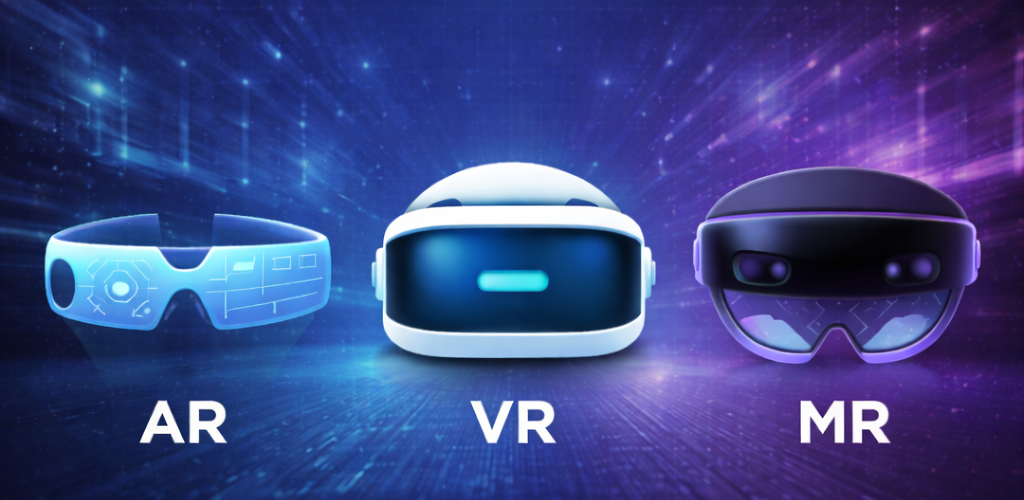
AR vs VR vs MR is a common comparison people search for when trying to understand modern immersive technologies. Although these terms sound similar, each one works differently and serves a distinct purpose in real world applications.
By understanding the difference between Augmented Reality, Virtual Reality, and Mixed Reality, you can choose the right technology for learning, business, gaming, or development.
What is Augmented Reality (AR)
Augmented Reality adds digital elements to the real world instead of replacing it. In other words, it enhances what you already see around you.
Typically, AR works through smartphones, tablets, or smart glasses. While the real environment remains visible, virtual objects appear layered on top of it.
Examples of AR
- Instagram and Snapchat filters
- Google Maps live navigation
- Pokémon Go
- Furniture preview apps like IKEA Place
Where AR is used
- Education and training
- Retail and e commerce
- Marketing and advertising
- Navigation and mapping
Because AR runs on everyday devices, it is easy for most users to access.
What is Virtual Reality (VR)
Virtual Reality creates a fully digital environment and blocks out the real world completely. As a result, the user feels placed inside a simulated space.
To experience VR, users need special hardware such as headsets and controllers. Once the headset is on, everything visible becomes virtual.
Examples of VR
- VR gaming experiences
- Virtual tours and simulations
- Flight and driving simulators
- Virtual classrooms
Where VR is used
- Gaming and entertainment
- Skill based training
- Medical simulations
- Architecture and design walkthroughs
Overall, VR offers deep immersion, but it depends heavily on dedicated devices.
What is Mixed Reality (MR)
Mixed Reality combines elements of both AR and VR. However, it goes a step further by allowing virtual objects to interact with the real world.
Unlike AR, MR understands physical space. Because of this, virtual objects can stay fixed in position and respond to real world movements.
Examples of MR
- Microsoft HoloLens
- Industrial training simulations
- Advanced design and engineering tools
Where MR is used
- Manufacturing and maintenance
- Healthcare training
- Engineering and design
- Enterprise level applications
At present, MR is powerful but expensive, which is why it is mostly used in professional environments.
AR vs VR vs MR Comparison Table
| Feature | AR | VR | MR |
|---|---|---|---|
| Real world visible | Yes | No | Yes |
| Immersion level | Low to medium | High | Medium to high |
| Hardware needed | Smartphone or glasses | VR headset | Advanced headset |
| User interaction | Limited | Fully virtual | Real and virtual |
| Cost | Low | Medium | High |
| Common use | Filters, navigation | Gaming, simulations | Enterprise training |
Key Differences Explained Simply
In simple terms, AR enhances reality, VR replaces reality, and MR blends real and virtual elements together.
While AR focuses on convenience, VR focuses on immersion. Meanwhile, MR focuses on interaction between digital content and the physical world.
Which One Should You Learn or Use
Choose AR if you want fast adoption and mobile based experiences.
On the other hand, choose VR if you want immersive environments like games or simulations.
Finally, choose MR if you work in enterprise, engineering, or advanced training fields.
Ultimately, the right choice depends on your budget, hardware access, and use case.
Final Thoughts
AR vs VR vs MR is not about which technology is better. Instead, it is about how each one solves a different problem.
AR enhances what you see.
VR transports you somewhere else.
MR allows both worlds to interact.
Check out our resources!
- Bootstrap Templates: Explore our Bootstrap Projects section.
- Free E-Books: Download your Free E-Books here.