Description
Introduction
Artificial Intelligence is one of the fastest-growing and highest-paying technology fields today. Companies across healthcare, finance, education, e-commerce, robotics, and automation are actively hiring skilled AI engineers. However, many learners struggle because they don’t know what to learn, when to learn, and in which order.
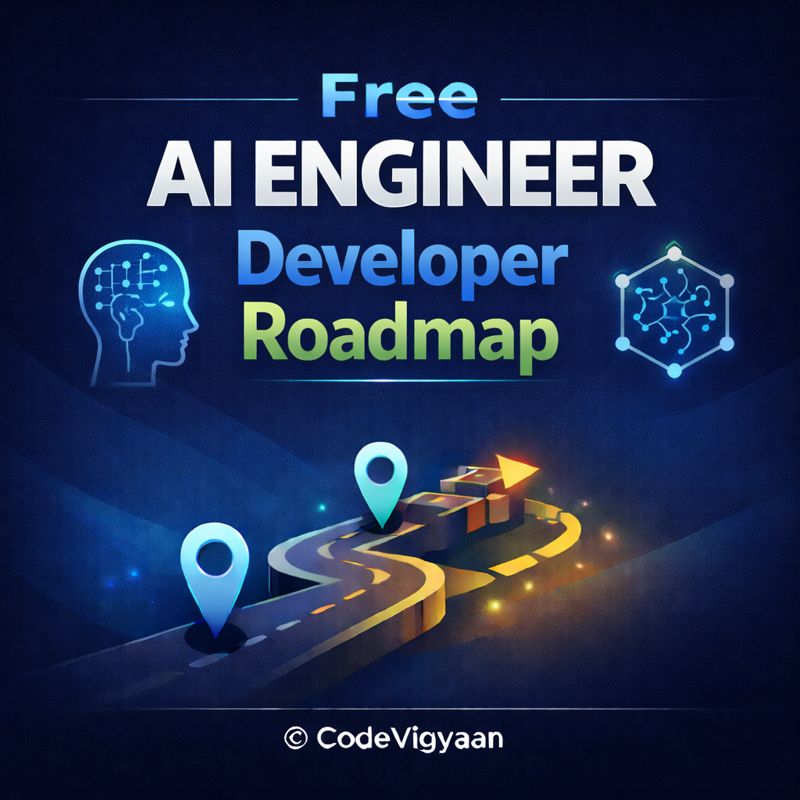
The Free AI Engineer Developer Roadmap solves this problem by providing a clear, structured, and industry-aligned learning path. This roadmap is specially created for beginners who want to start AI from zero and gradually move toward professional-level AI engineering roles.
Phase 1: Programming & Math Foundations
Before diving into AI, you must build a strong base.
Programming Skills
Python fundamentals
Data types, loops, functions
Object-oriented programming (OOP)
File handling and exception handling
Mathematics for AI
Linear algebra (vectors, matrices)
Probability and statistics
Basic calculus (gradients, optimization concepts)
Why this matters: AI models rely heavily on math and logic. Strong foundations make advanced concepts easy.
Phase 2: Data Handling & Data Science Basics
AI is driven by data. Understanding data is mandatory.
Data collection and cleaning
Data visualization (charts, graphs)
Exploratory Data Analysis (EDA)
Working with CSV, JSON, APIs
Tools to Learn
NumPy
Pandas
Matplotlib / Seaborn
Phase 3: Machine Learning Core Concepts
This phase introduces the heart of AI.
Supervised Learning
Linear regression
Logistic regression
Decision trees
Random forest
Unsupervised Learning
Clustering (K-Means)
Dimensionality reduction
ML Workflow
Model training
Testing & validation
Bias-variance tradeoff
Performance metrics
Phase 4: Deep Learning & Neural Networks
Deep learning powers modern AI applications.
Artificial Neural Networks (ANN)
Convolutional Neural Networks (CNN)
Recurrent Neural Networks (RNN)
Transformers basics
Frameworks
TensorFlow
PyTorch
Use case examples: Image recognition, speech systems, recommendation engines.
Phase 5: NLP & Computer Vision
Natural Language Processing
Text preprocessing
Sentiment analysis
Chatbots
Language models
Computer Vision
Image classification
Object detection
Face recognition
Phase 6: AI Deployment & MLOps
Learning AI is incomplete without deployment.
Model deployment basics
REST APIs for AI models
Cloud platforms fundamentals
Monitoring & updating models
Phase 7: Real-World AI Projects
Projects prove your skills.
Project Ideas
AI chatbot
Resume screening system
Image classification app
Recommendation system
AI-powered analytics dashboard
Tip: Focus on problem-solving, not just model accuracy.
Phase 8: Career Preparation
AI Engineer resume building
GitHub portfolio optimization
Interview preparation
Freelancing & job opportunities
AI ethics & responsible AI
Who Should Follow This Roadmap?
Computer science students
Engineering students
Fresh graduates
Career switchers
Working professionals
Self-taught developers
Final Words
The Free AI Engineer Developer Roadmap is not just a learning plan — it is a complete career blueprint. If followed step by step with discipline and hands-on practice, this roadmap can take you from beginner level to industry-ready AI engineer without paid courses.
Frequently Asked Questions
Yes, becoming an AI engineer is a great career choice. AI is transforming nearly every industry, from healthcare and finance to transportation and entertainment. As companies increasingly adopt AI-driven solutions, the demand for skilled AI engineers continues to grow. This role offers opportunities to work on cutting-edge technologies like machine learning, natural language processing, and computer vision, making it a highly innovative field.
What is reinforcement learning?
Reinforcement learning (RL) is a type of machine learning where an agent learns to make decisions by interacting with an environment. Unlike traditional supervised learning, RL does not rely on labeled data. Instead, the agent learns by taking actions and receiving feedback in the form of rewards or penalties. Over time, it aims to maximize cumulative rewards by refining its strategy based on past experiences. RL is often used in areas like robotics, game AI, and autonomous systems, where the goal is to develop intelligent behaviors through trial and error.
Do AI Engineers need a degree?
While a degree in computer science, data science, or a related field can provide a solid foundation for becoming an AI engineer, it is not strictly necessary. Many successful AI engineers are self-taught or have gained expertise through online courses, certifications, and hands-on projects.
For more projects, study materials and many more.
Visit → https://codevigyaan.com/bootstrap-projects
Want HTML & CSS projects?
Open → https://codevigyaan.com/projects/
For more free study material and handwritten notes?
Open → https://codevigyaan.com/free-e-books/