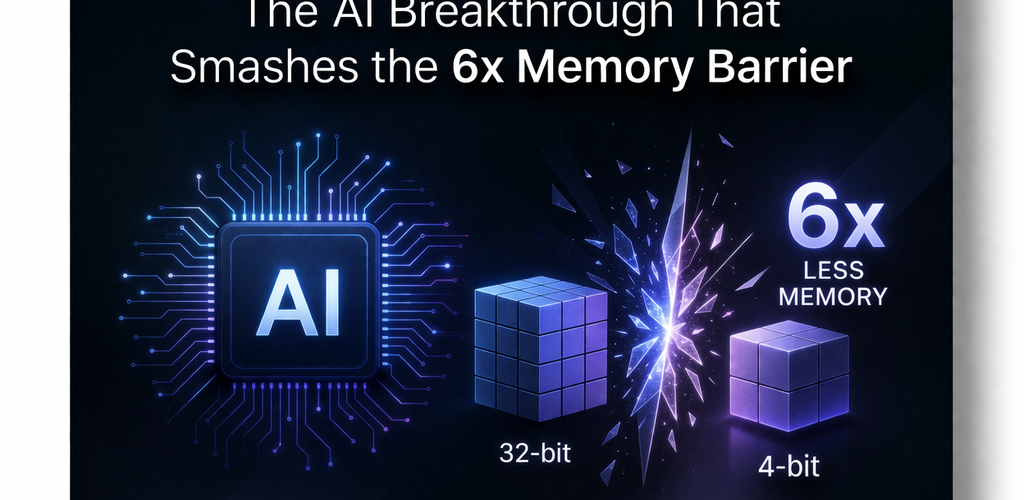
Google TurboQuant: The AI Breakthrough That Smashes
A recent Google Research blog post on the TurboQuant has called it ”‘a mathematical firewall’ to keep the bottlenecks of today‘s most advanced AI.’
Here is the breakdown of the blog’s details in simple terms.
The Problem: The “Memory Tax”
With every extended call, an AI has to recall what you just said all the way up to the present so it can understand what you‘ll be saying next. It works as a time machine and saves this “context” in a special digital notepad called the Key-Value (KV) Cache.
- The Issue: The longer the conversation, the bigger this notepad gets.
- The Bottleneck: When your device, through insufficient memory (RAM), can‘t contain of the information that the AI has already thought of, this causes the AI to “slowdown”, “forget” the earlier parts of the chat, or crash altogether.
- The Failed Fix: Traditional methods of reducing this data would often “break” the AI, leading it to hallucinate or otherwise lose its coherency.
The Solution: How TurboQuant Works
TurboQuant uses a two-stage process to shrink that “digital notepad” by 6x without losing a single bit of intelligence.
1. Stage One: The “Polar” Spin (PolarQuant)
Conventional compression is looking at data in “XYZ” coordinates, which is messy, and it needs other “cheat sheets” (metadata) to tell you how to un pack it.
- The Trick: TurboQuant first “rotates” the data randomly and then switches to Polar Coordinates (measuring the radius and the angle).
- The Result: Because the angles become highly predictable after the spin, the AI doesn’t need those extra “cheat sheets” anymore. This removes the “overhead” that usually ruins compression gains.
2. Stage Two: The Error Corrector (QJL)
A few small mistakes can be made even on the first step. TurboTax uses an algorithm called Quantized Johnson- Lindenstrauss (QJL) to correct.
- The Trick: It uses just 1 extra bit per value to act as a mathematical error-checker.
- The Result: It ensures the AI’s “attention” (its ability to focus on the right words) stays exactly as sharp as the uncompressed version.
The Results (By the Numbers)
Google tested this on popular models like Gemma and Mistral, and the findings were massive:
- 6x Memory Reduction: What used to take 6GB of “working memory” now only takes 1GB.
- 8x Speed Boost: On high-end chips like the NVIDIA H100, the AI can process information much faster.
- Zero Accuracy Loss: In “Needle-in-a-Haystack” tests (finding one specific fact in 100,000 words), the compressed AI scored perfectly.
Why This Matters for You
This isn’t just for big data centers. Because the memory requirement is so much lower:
- Local AI: You’ll be able to run powerful AI models entirely on your phone or a basic laptop without needing the cloud.
- Longer Chats: Your AI assistants can remember weeks of conversation or massive documents without getting “confused” or slowing down.
- Cheaper Tech: By reducing the demand for expensive AI memory chips, it could eventually help lower the price of gadgets and AI subscriptions.
Check out our resources!
- Bootstrap Templates: Explore our Bootstrap Projects section.
- Free E-Books: Download your Free E-Books here.