Intel vs. AMD 2026: The Battle for the AI PC and 2nm Supremacy
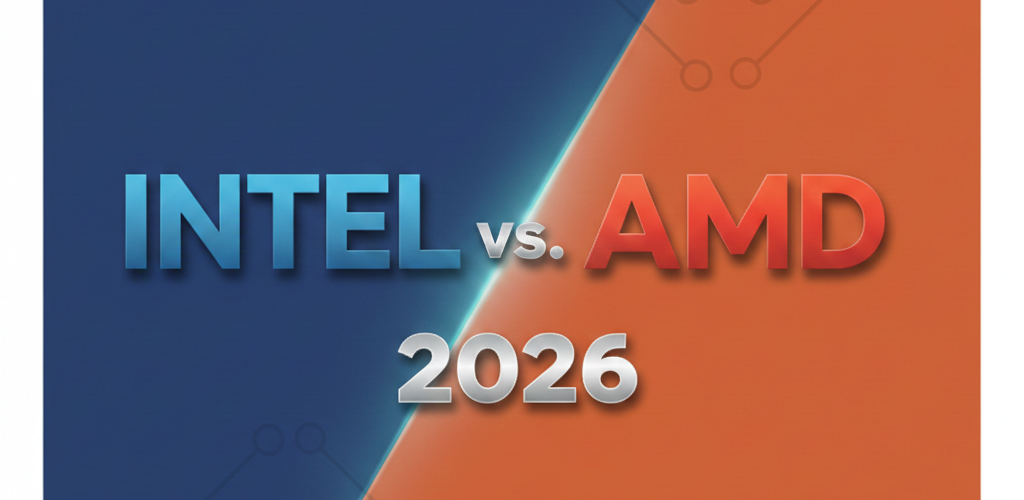
The long-standing rivalry between Intel and AMD has entered its most volatile phase yet. As we move through 2026, the “Processor War” is no longer just about core counts or gigahertz. It has shifted into a high-stakes competition over NPU (Neural Processing Unit) TOPS, backside power delivery, and manufacturing independence.
Whether you are a gamer looking for the highest FPS or a professional seeking the ultimate “AI PC,” the choice between Team Blue and Team Red has never been more complex.
The Desktop King: AMD Ryzen 9000X3D vs. Intel Arrow Lake Refresh
In the enthusiast desktop space, the battle lines are drawn between raw efficiency and gaming-first innovation.
AMD’s Gaming Stronghold
AMD continues to dominate gaming benchmarks with the Ryzen 7 9850X3D. By utilizing second-generation 3D V-Cache technology, AMD has managed to mitigate thermal bottlenecks, allowing for higher clock speeds while maintaining a massive L3 cache. For pure gaming, the 9850X3D remains the undisputed king of 2026, often delivering up to 30% higher minimum FPS than Intel’s best.
Intel’s Efficiency Pivot
Intel’s Arrow Lake Refresh (Core Ultra Series 2 for Desktop) has abandoned the “power at all costs” mantra. These chips focus on a refined hybrid architecture that significantly reduces power draw compared to the 14th Gen “Raptor Lake” era. While Intel trails in gaming FPS, they lead in single-threaded productivity and specialized AI workflows on the desktop.
The Mobile Revolution: Panther Lake vs. Gorgon Point
The most aggressive fighting is happening in our laptops. With the rise of “Agentic AI” (AI that performs tasks for you), the NPU is now the most important spec on the box.
| Feature | Intel Core Ultra Series 3 (Panther Lake) | AMD Ryzen AI 400 (Gorgon Point) |
| Manufacturing | Intel 18A (RibbonFET) | TSMC 4nm / 3nm |
| Graphics | Xe3 “Celestial” | Radeon RDNA 3.5 |
| AI Power | 180 Total Platform TOPS | 55+ NPU TOPS |
| Best For | Ultra-portables & Battery Life | Creative Pros & High-end Handhelds |
Intel 18A: The Manufacturing Gamble
Intel’s Panther Lake is a historic milestone. It is the first high-volume consumer chip built on the Intel 18A node, featuring PowerVia (backside power delivery). This allows for a massive jump in efficiency, with Intel claiming laptop battery life can now exceed 25 hours under light AI workloads.
AMD Gorgon Point: The Multi-core Monster
AMD’s Ryzen AI 400 series (Gorgon Point) focuses on “refined execution.” While Intel is experimenting with new nodes, AMD is using a matured Zen 5/5c architecture to deliver incredible multi-threaded performance. In early 2026 benchmarks, the Ryzen AI Max+ 395 still beats Intel’s flagship mobile chips in heavy content creation tasks like 8K video rendering.
The Verdict: Which Should You Buy in 2026?
Choose AMD If:
- You are a hardcore gamer: The 3D V-Cache (X3D) models are still unbeatable for smooth, high-refresh-rate gaming.
- You are a heavy creator: AMD’s multi-core performance-per-dollar in the high-end segment remains superior.
- You value platform longevity: The AM5 socket continues to support new generations, making it easier to upgrade in the future.
Choose Intel If:
- You want the ultimate AI PC: Intel’s integration with Microsoft’s “Physical AI” and Copilot+ ecosystem is currently more seamless.
- You need extreme battery life: The Panther Lake chips on the 18A node have finally closed the gap with Apple’s M-series silicon.
- You do specialized professional work: Intel’s QuickSync and single-core optimizations still hold the edge in many enterprise applications.
Looking for clean code? Explore our latest Bootstrap Projects.
Want to stay ahead of the curve? Download our latest tech guides in the Free E-Books section.