SaaSpocalypse 2026: Why AI Agents Are Shaking Software Stocks
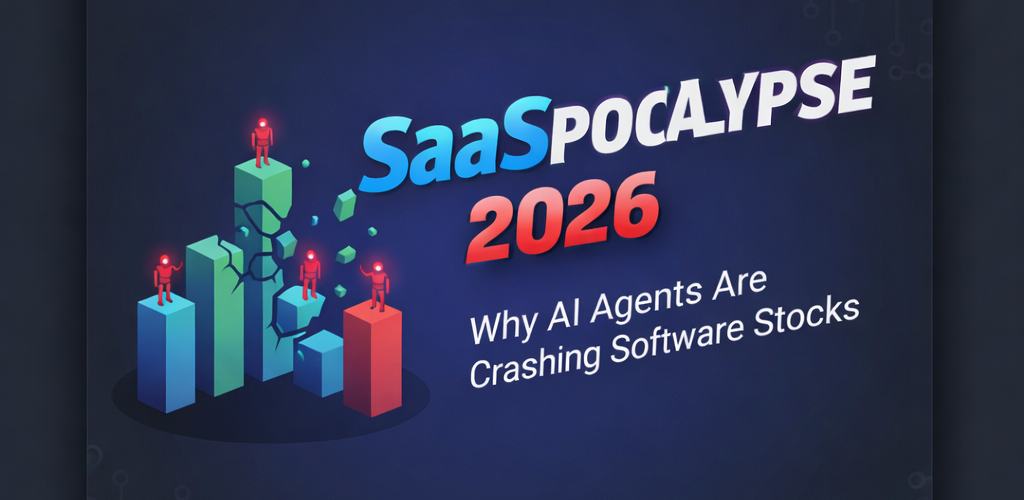
SaaSpocalypse 2026 is the name given to the massive drop in software company stocks that happened in early February 2026. In just one week, more than $1 trillion in value disappeared from the SaaS sector. This event marked a major turning point, as investors began to question whether traditional Software as a Service companies can survive in the age of AI agents.
Let’s understand this in simple terms.
What Does “SaaSpocalypse” Mean?
The word SaaSpocalypse is made from two words:
- SaaS – Software as a Service. This is software you pay for monthly or yearly, like subscriptions.
- Apocalypse – A sudden, dramatic collapse or disaster.
So, SaaSpocalypse means a sudden crash or major disruption in the SaaS industry.
It does not mean software is ending. It means the traditional way software companies make money is under serious pressure because of AI.
1. What Triggered the SaaSpocalypse?
On January 30, 2026, Anthropic released new plugins for its AI tool Claude Cowork.
These plugins allowed the AI to act like a digital employee. It could:
- Do research
- Write documents
- Organize files
- Perform tasks directly on a computer
This was not just AI answering questions. It was AI actually doing office work.
The Legal Industry Reaction
After this release:
- Thomson Reuters shares dropped sharply.
- RELX, which owns LexisNexis, also fell heavily.
Why?
Because AI agents could now perform legal research and draft documents without lawyers using traditional legal software step by step.
Investors realized that AI might reduce the need for many existing software tools.
2. The “Software Seat” Problem
Most SaaS companies earn money using the seat model.
A company pays per user. For example:
- 50 employees using Salesforce
- 100 employees using ServiceNow
More users means more revenue.
But now imagine this.
If one AI agent can do the work of 10 employees, a company may only need 1 seat instead of 10.
That means less money for SaaS companies.
This fear is called seat contraction, and it is one of the biggest reasons stocks fell.
Even Satya Nadella from Microsoft has mentioned that many business apps are mainly databases with logic. If AI handles the logic, the app interface becomes less important.
3. Which Companies Were Affected?
Legal Tech
Companies like Thomson Reuters and RELX were hit because AI can now automate research and document drafting.
Enterprise Software
Salesforce, ServiceNow, and HubSpot faced pressure due to fears of fewer paid users.
IT Services
Indian IT firms like Infosys, TCS, and Wipro were also affected because AI can automate routine coding and data entry work.
Cybersecurity
CrowdStrike and Palo Alto Networks initially fell. Later, experts said they might benefit since AI agents still need security and monitoring.
4. Why Did Some Companies Stay Strong?
Not every company suffered.
Microsoft
Microsoft owns Azure cloud services and partners with OpenAI.
More AI agents mean more cloud computing demand. That supports Microsoft’s growth.
Nvidia
Nvidia makes powerful GPUs used to run AI models.
No matter which software wins, AI still needs computing power. That keeps Nvidia strong.
5. The Bigger Picture
The SaaSpocalypse is not about software disappearing.
It is about a shift in how value is created.
Earlier:
Companies paid for software so humans could use it.
Now:
Companies may pay for AI agents that complete tasks automatically.
Investors are moving money toward companies that provide:
- Cloud infrastructure
- AI models
- Chips and computing power
Instead of companies that only sell user subscriptions.
Final Simple Takeaway
SaaSpocalypse means a major shake up in the SaaS industry caused by AI agents.
AI is no longer just helping humans use software. It is starting to replace parts of the workflow itself.
Check out our resources!
- Bootstrap Templates: Explore our Bootstrap Projects section.
- Free E-Books: Download your Free E-Books here.